info@statelinetech.net

- info@statelinetech.net
LazeraH Pursues Ultra Dense Hydrogen Energy With Havard Lillebo and Professor Leif Holmlid
Brand News 24
|
November 5, 2026
Entrepreneurial experience and published hydrogen research underpin a Swedish venture exploring the scientific foundations of energy conversion through surface chemistry and particle physics.
North Vancouver, BC, Canada, 5th Nov 2026 - LazeraH AB brings together two careers with complementary strengths: Havard Lillebo’s experience building technology companies and Professor Leif Holmlid’s longstanding research into hydrogen, catalytic surfaces and unusual condensed states of matter. As CFO and cofounder, Lillebo contributes the business perspective. As inventor, CTO and cofounder, Holmlid provides the scientific foundation for the company’s ultra-dense hydrogen and proposed antimatter energy programme.
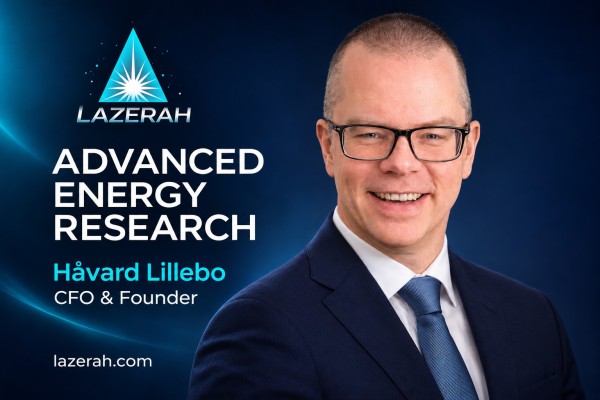
Their shared undertaking addresses a demanding question: can phenomena investigated in hydrogen experiments become a reproducible, measurable and ultimately useful energy technology? Answering it requires sustained laboratory work and an organisation capable of supporting that work over time. LazeraH’s story sits at that intersection of experimental science and technology entrepreneurship.
A recent publication provides a concrete view of the research. In March 2026, Chemical Physics published a micro-Raman study by Holmlid and Linnéa Gunnarsson examining hydrogen precursor states at a catalyst surface. The authors identify the project as research within LazeraH AB. It connects the company’s wider energy ambition to a specific scientific task: understanding the material and electronic states involved before interpreting their possible nuclear behaviour.
Havard Lillebo and the Business of Deep Technology
Havard Lillebo’s background offers a practical perspective on the distance between a promising technical idea and an operating industrial business. His experience includes solar manufacturing, autonomous robotics and advanced coatings. These are fields where scientific performance must eventually meet production requirements, financing constraints and the expectations of customers investing in unfamiliar technology.
His involvement in Innotech Solar is documented in Investinor’s 2009 annual report. The account identifies Lillebo, Dr Timothy Lommasson and Bård Andreassen as the founders, following their work together at REC ScanCell in Narvik. Their commercial idea involved upgrading lower-grade solar cells using proprietary technology. The report also describes Northzone Ventures’ involvement and Lillebo’s decision to recruit experienced leadership while taking a finance role.
That decision became a theme in his September 2023 Forbes interview. Lillebo described bringing Thor Christian Tuv into the CEO position shortly after Innotech Solar began. He recalled the team developing the business to 180 employees, multiple factories and €35 million in revenue. These are his retrospective figures, illustrating the scale of the manufacturing experience he describes.
The same interview gives his approach a human dimension. “Identifying brilliant people and finding worthy problems to solve together” was how he described his guiding principle. He also discussed liquidity management and the lessons of financing factory expansion. For an experimental energy venture, that combination of recruiting capable people and respecting financial constraints has clear relevance.
Investinor’s earlier account adds an important detail to that leadership story. Lillebo viewed experienced investors as participants in execution, bringing judgement and networks alongside capital. The report records Sustainable Technologies Fund and Investinor joining the investor group in 2009. His decision to work beside an experienced CEO illustrates a willingness to organise around the company’s needs, a useful quality when a venture depends on people with highly specialised knowledge.
Lillebo’s subsequent work spans other demanding technical markets. Investor Valinor identifies him as a 2019 cofounder of Watbots, which develops autonomous systems for fish-farming net maintenance and inspection. Nanize’s leadership profile identifies him as CFO and founder of the coatings company and credits him with raising $140 million across his companies. That career total is distinct from LazeraH’s financing.
Nanize provides another example of working alongside scientific founders. Its team includes CTO and founder Dr Kingsley Iwu, whose background is in chemistry and materials science. The company describes its focus on rapidly curing polysilazane coatings. Lillebo’s role there places financial organisation alongside specialist chemistry, a combination relevant to understanding his contribution at LazeraH. Each venture has its own technology and development requirements, while the recurring business challenge concerns supporting expertise with an effective organisation.
At LazeraH, his background is relevant to financing research, assembling specialist teams and communicating development priorities. An experiment consumes resources long before a product earns revenue. Company building in this setting depends on matching expenditure to scientific questions and giving researchers the time, equipment and organisational support needed to answer them properly.
Professor Leif Holmlid and Hydrogen Surface Science
Professor Leif Holmlid brings the other essential part of the story. A professor emeritus associated with the University of Gothenburg, he has published research across surface processes, spectroscopy and hydrogen physics. His publisher author profile records a substantial scientific publication history, while individual papers provide the detailed basis for examining his experimental methods and interpretations.
LazeraH traces its scientific background to Holmlid’s Rydberg matter research and identifies 2009 as the year of his first peer-reviewed publication on H(0). The company was established in 2021. That chronology places LazeraH within a longer research effort, with its commercial organisation emerging after years of work on the underlying material and the signals attributed to it.
Holmlid’s scientific interests connect fields that are often discussed separately. Surface chemistry concerns what happens when hydrogen interacts with a material. Spectroscopy examines electronic or molecular states through their interaction with light. Particle detection investigates energetic emissions and their origin. The energy question depends on understanding how observations across these different scales fit together.
The development history also includes university innovation activity. In 2019, GU Ventures described work with Holmlid on proposed clean energy concepts involving deuterium and muon-related fusion research. That dated account provides context for the programme’s origins. The current scientific discussion can be followed through Holmlid’s later papers on ultra-dense hydrogen, meson signals and energy conversion.
Holmlid and Sindre Zeiner-Gundersen’s 2019 Physica Scripta review brought together work on ultra-dense protium and deuterium and their proposed relationship with ordinary Rydberg matter. A review of this kind gives specialists a route through earlier experiments and the model used to interpret them. For LazeraH’s readers, it also establishes the scientific vocabulary behind the company’s references to condensed hydrogen, precursor states and isotope-dependent behaviour.
Holmlid subsequently addressed the energy proposition in a 2021 International Journal of Hydrogen Energy paper on laser-induced annihilation. That publication presents his interpretation of the reported processes as a potential energy source. Read alongside the materials literature, it shows how the research agenda extends from describing a proposed hydrogen state to examining what its claimed nuclear behaviour could mean for energy production.
For readers evaluating Professor Leif Holmlid’s work, the most informative starting point is the published research itself. It exposes the experimental arrangements, proposed mechanisms and questions that specialists can analyse. This gives LazeraH’s scientific story a body of literature through which interested laboratories and technical partners can engage with the actual subject matter.
Ultra Dense Hydrogen and Rydberg Matter
Ultra-dense hydrogen, written H(0) in this literature, is the proposed condensed hydrogen state at the centre of LazeraH’s research framework. Associated papers describe exceptionally short interatomic separations. Establishing the structure and properties of that proposed state is therefore a fundamental materials question, with consequences for how subsequent laser and radiation measurements should be interpreted.
The 2021 production review by Holmlid, Andrzej Kotarba and Paweł Stelmachowski outlines a pathway involving catalytic surfaces and electronically excited species. In their model, alkali-promoted surfaces support the formation of Rydberg species, which interact with hydrogen. Hydrogen Rydberg clusters are then proposed as precursors to H(0). The review connects surface preparation with the material formation process being investigated.
This is why catalyst chemistry deserves attention alongside reactor terminology. Surface composition, hydrogen adsorption and the population of excited states influence what an experiment is actually examining. A study of ultra-dense hydrogen production must therefore address the preparation history of the sample, the measurement method and the relationship between the observed signals and the proposed structure.
The isotope terminology also matters. Protium is ordinary hydrogen with a single proton in its nucleus; deuterium contains a proton and a neutron. Their different nuclear compositions make isotope comparisons useful in hydrogen research. Holmlid’s literature discusses both protium and deuterium, giving researchers opportunities to examine whether proposed material behaviour and detected emissions depend on the hydrogen isotope used.
Raman Spectroscopy Adds a Recent Scientific Development
The March 2026 Chemical Physics paper places a recognisable analytical method at the centre of this investigation. Holmlid and Gunnarsson report micro-Raman measurements of hydrogen species on a potassium-containing catalyst. They assign anti-Stokes features to electronically excited atomic hydrogen and describe transitions observed at approximately 320 kelvin. Their interpretation supports the presence of Rydberg species involved in the proposed precursor pathway.
The author statement identifies Gunnarsson’s contribution to performing and analysing the experiments, alongside Holmlid’s experimental design and manuscript work. This provides a specific example of LazeraH’s research activity and the participation of its scientific team. The paper’s focus is precursor chemistry and spectroscopy, making it an important part of the material characterisation question.
Antimatter Research and the Interpretation of Particle Signals
LazeraH’s technology overview describes an energy concept based on processes the company interprets as matter-antimatter annihilation in association with H(0). The terminology is ambitious because it refers to nuclear and particle processes, extending beyond the chemical energy involved in conventional hydrogen applications. The scientific question concerns the mechanism responsible for the reported emissions.
Here, a basic distinction helps readers follow the research. H(0) is the notation used for a proposed state of ordinary hydrogen. Antihydrogen consists of an antiproton and a positron, as explained by CERN’s antihydrogen material. Identifying a proposed condensed hydrogen state and establishing an annihilation process are separate scientific tasks, each requiring its own measurements.
In their 2021 High Energy Density Physics paper, Holmlid and Sveinn Olafsson report energetic signals from laser-induced processes in material described as H(0). They interpret decay-time patterns as signatures of mesons, including kaons and pions, and their decay products. Their proposed explanation involves baryon annihilation. This paper provides a primary reference for understanding the particle interpretation behind LazeraH’s antimatter energy research.
The interpretation makes particle identification central to the development programme. Timing measurements, detector response, charge sensitivity and energy measurements need to support a consistent account of the emitted radiation. Specialist involvement in these measurements can make the discussion more informative by connecting a broad energy proposition to the particular observations on which it depends.
Muons and the Wider Nuclear Research Context
Muon production features in Holmlid’s associated research because negative muons can participate in muon-catalysed fusion. A muon can replace an electron in a hydrogen-isotope system, bringing nuclei closer together and facilitating fusion. Producing useful muons efficiently is therefore a research question with significance beyond any single proposed reactor concept.
A 2023 paper on reported charge asymmetry examines signals that Holmlid assigns to muons generated from ultra-dense hydrogen. The author discusses their interpretation in terms of secondary processes, including muon capture and muonium formation. This adds another defined subject to the literature: how particle charge, interactions with surrounding materials and detector measurements influence the observed result.
Muon-catalysed fusion and the annihilation process proposed for H(0) are distinct pathways. A useful research programme examines the evidence for a particle source separately from any later use of those particles. That distinction gives collaborators a clearer basis for discussing production efficiency, useful yield and the measurements needed to connect a source with an energy application.
Radiation Diagnostics and Independent Experimental Work
The wider field includes experimental apparatus developed outside LazeraH. In a 2024 Journal of Instrumentation paper, S. A. Zeiner-Gundersen and S. Olafsson describe a chamber supporting different detectors for hydrogen, condensed excited hydrogen, Rydberg matter and radiation studies. Their setup combines laser excitation, ion time-of-flight measurements and radiation monitoring.
The authors report partial replication of particle-acceleration observations and describe the apparatus as a platform for further studies. For readers interested in research collaboration, the importance lies in the instrumentation: interchangeable detectors and documented experimental conditions make particular observations available for further investigation. The paper concerns experimental capability and reported measurements, rather than a demonstrated commercial energy system.
Their 2024 AIP Advances paper examines spontaneous and laser-induced radiation associated with hydrogen Rydberg matter. The authors describe penetrating radiation with x-ray-like characteristics from a potassium-containing iron-oxide catalyst system and call for investigation by other teams. This result is a distinct radiation observation; it does not independently establish the proposed meson or annihilation interpretation.
Another 2024 study by Tor Havard Aasen and Kaiying Wang investigates laser-targeted Rydberg matter under changing pressure and magnetic fields. Their measurements show how experimental conditions influence time-of-flight features, and they discuss possible photon emission. Together, these papers give technical readers specific methods and variables to examine within the broader hydrogen research literature.
Meson Energy Conversion and Thermal Engineering
For LazeraH, the engineering question extends to capturing useful energy from the proposed particle source. Published disclosure WO2024058692A1, naming Holmlid and Dan Gall as inventors and LazeraH AB as assignee, describes a meson converter intended to generate thermal energy from a meson flux. It provides a concrete technical reference for the company’s energy-conversion concept.
The proposed converter combines absorber layers with heat-transport layers. Its purpose is to address how particle energy might be deposited in a structure and transferred into a thermal system. This links particle physics with materials selection and heat management, disciplines that become essential when considering how an experimental source could support an eventual energy device.
A published patent disclosure sets out an engineering approach for examination. Experimental performance requires measurement of the source and converter together. Relevant work includes calorimetry, thermal losses, operating stability and uncertainty analysis. These are practical areas in which engineering partners could contribute specialist expertise while assessing whether the proposed conversion approach produces useful, reproducible results.
Research Validation and Development Milestones
Scientific scrutiny shapes this programme. H(0) and the interpretation of the reported nuclear signals remain contested. Hansen and Engelen challenged the claimed muon source in 2023, and Holmlid published a response. Their exchange makes independent replication and selective particle identification central to evaluating the programme. Published observations, proposed explanations and demonstrated system performance should each be assessed on their own terms.
Complete energy accounting is equally important. A system evaluation must include electrical supply, laser efficiency, vacuum equipment, controls and the energy recovered over a defined operating period. Comparing output with laser-pulse energy alone cannot establish the performance of the complete installation. Careful measurements give researchers, partners and investors a common basis for judging progress.
These requirements also explain the value of Lillebo and Holmlid’s different responsibilities. Scientific leadership defines experiments and interprets their results. Financial and organisational leadership helps sustain the work and establish priorities. Their combined experience is relevant to a development process in which progress depends on resolving technical questions before committing to broader industrial deployment.
A productive collaboration can begin with an agreed measurement question, access to the relevant methods and a clear account of uncertainty. That structure allows a spectroscopy group, detector specialist or engineering partner to contribute within its expertise. It also makes progress easier to communicate: a characterised spectrum, an independently identified radiation component or a measured thermal balance provides more information than a broad forecast of future output.
A Focused Opportunity for Scientific and Industrial Partners
LazeraH’s organisational development has documented milestones. In October 2023, GU Ventures reported SEK 8.6 million in funding for the company’s next development steps. This is a historical financing event, providing context for the resources assembled around the research. The later spectroscopy publication offers a separate, concrete example of ongoing scientific output.
The company also appears in the wider Swedish climate technology ecosystem. A February 2025 GU Ventures update identifies LazeraH as an alumnus company among ventures associated with the Swedish Climate Startup Map. This context is relevant to partners seeking research businesses within Sweden’s energy innovation community. Useful engagement can connect scientific expertise with manufacturing, measurement and financing capabilities needed for development. Such relationships become productive when participants agree on the technical problem, their expected contributions and how the resulting work will be evaluated.
Prospective collaborators can approach LazeraH through specific technical capabilities. Surface scientists can examine catalysts and precursor states. Spectroscopy groups can assess optical signatures. Particle physicists can investigate radiation identity, while thermal engineers can evaluate energy capture. These contributions address identifiable scientific questions and give potential partnerships a practical starting point.
For industrial energy companies, future applications would depend on verified useful output, operating reliability and application-specific engineering. Industrial heat and distributed energy are understandable areas for eventual evaluation because energy conversion must ultimately meet real operating requirements. Early technical engagement can help define those requirements while the underlying physics and system performance are investigated.
The LazeraH Team and Its Scientific and Business Leadership
The company’s leadership page places Lillebo and Holmlid alongside CEO and cofounder Erling Nilsen and COO Frans Olofson. It also lists research capabilities in physical chemistry, spectroscopy and data analysis. That wider team matters because understanding a proposed hydrogen energy process requires expertise across preparation, measurement, interpretation and engineering.
LazeraH gives their complementary careers a shared focus. Lillebo’s record concerns building businesses around difficult technologies. Holmlid’s concerns investigating hydrogen and interpreting experimental observations. The company’s opportunity is to connect those capabilities through a sustained research programme whose progress can be examined in published papers, technical disclosures and reproducible measurements. This combination gives prospective partners a direct route to discussing both the scientific work and the resources needed to advance it.
Researchers, specialist investors and prospective industrial partners can explore the LazeraH scientific FAQ and contact the company for discussions grounded in the relevant experiments and development priorities. For those seeking a substantive conversation about ultra-dense hydrogen, Rydberg matter and proposed antimatter energy conversion, LazeraH offers a defined research programme and identifiable people with whom to engage. The next conversation can begin with a specific experiment.
About LazeraH
LazeraH AB is a Swedish research and development company investigating ultra-dense hydrogen H(0), associated particle-emission processes and proposed energy-conversion systems. Its scientific foundation draws on Professor Leif Holmlid’s research, supported by a team combining laboratory expertise with technology company experience. Havard Lillebo serves as CFO and cofounder.
Media research and partnership enquiries: contact@lazerah.com
Media Contact
Organization: OpenQQuantify
Contact Person: Paul Savluc
Website: https://www.openqquantify.com
Email: Send Email
Contact Number: +40751476842
Address: 560 Raven Woods Drive, suite 215
Address 2: suite 215
City: North Vancouver
State: BC
Country: Canada
Release id: 50475
View source version on King Newswire:
LazeraH Pursues Ultra Dense Hydrogen Energy With Havard Lillebo and Professor Leif Holmlid
Disclaimer: The views, recommendations, and opinions expressed in this content belong solely to the third-party experts. This site was not involved in the writing and production of this article.